Dog Proof Litter Box Solutions That Actually Work (By Dog & Cat Type)

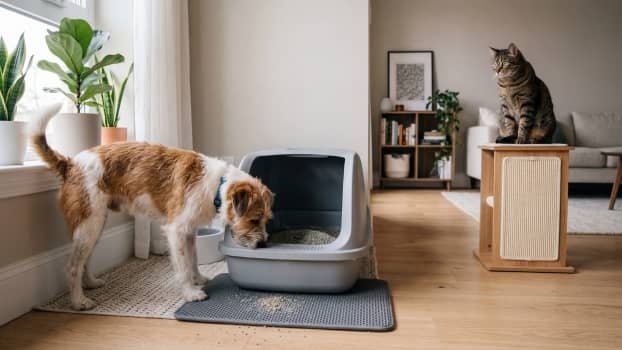
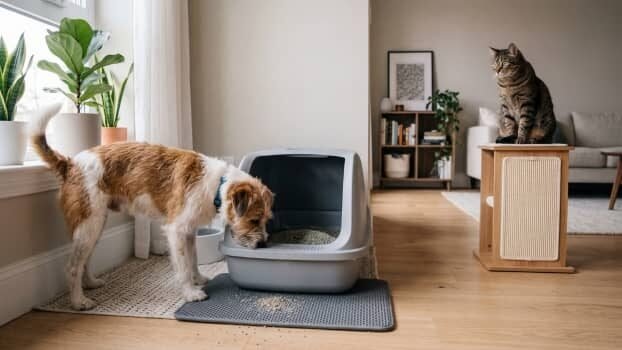
dog proof litter box problem with dog sniffing litter box and cat nearby

Disclaimer: This post may contain affiliate links. As an Amazon Associate, we earn from qualifying purchases.

Dogs don’t see a litter box the same way you do. What looks like waste to you smells like something worth investigating, and once a dog figures that out, it quickly turns into a habit.

dog proof litter box problem with dog sniffing litter box and cat nearby

A dog sniffing a litter box while a cat watches nearby, a common reason people look for a dog proof litter box.

A dog proof litter box becomes necessary at that point, because this is not something most dogs ignore on their own. They come back to it, wait nearby, and sometimes even push or tip the box to get closer.

Cleaning more often usually does not fix it, and standard covered boxes rarely stop a determined dog. The real solution is to choose a setup that your dog cannot access while still keeping things comfortable for your cat.

Once you match the setup to your dog’s size and your cat’s mobility, the problem becomes much easier to control and once access is blocked, it often stops completely.

What Actually Works

A dog proof litter box setup works best when your dog physically cannot reach what’s inside.

The most reliable options are:

  • top-entry litter boxes that block access from above
  • litter box furniture with hidden or offset entrances
  • door barriers that create a cat-only space
  • elevated setups that small dogs cannot reach

The right choice depends on your dog’s size, how determined they are, and how easily your cat can jump or move.

Why Dogs Are So Drawn to the Litter Box

Dogs go after the litter box for a simple reason. To them, it smells like food.

Cat food is higher in protein and fat than dog food, and not all of that gets fully digested. What ends up in the litter box still carries that scent, which makes it appealing instead of repulsive.

dog sniffing covered litter box while cat watches nearby

Dogs are often drawn to litter boxes because of the scent, which makes them keep coming back.

Once a dog investigates it the first time, the behavior tends to stick. The smell is strong, the location is predictable, and the reward is immediate. That combination makes it easy for the habit to form quickly.

Access plays a big role here. If the litter box is easy to reach, the dog doesn’t need to work for it. That’s why this problem shows up more in open layouts or when the box is placed on the floor without any barrier.

Boredom can make it worse. A dog that doesn’t have enough stimulation will look for something interesting to do, and the litter box becomes an easy target.

This is also why cleaning alone doesn’t solve the problem. Even a clean litter box still has enough scent to attract attention. The behavior only stops when access is removed or blocked in a way the dog can’t get around.

Why Most “Dog Proof” Litter Boxes Fail

A lot of litter boxes are labeled dog proof, but they don’t hold up once a dog is determined to get inside.

The biggest issue is front openings. Covered litter boxes look enclosed, but the entrance is still wide enough for most dogs to push their nose through. Once they realize that, the cover doesn’t do much.

Height alone is another common mistake. Dogs may not jump like cats, but they don’t need to. They can lean forward, reach down, or circle the box until they find an angle that works.

Lightweight boxes create a different problem. Some dogs don’t even try to reach in. They flip the box, drag it, or shove it against a wall until they can get access.

There’s also the issue of the cat’s comfort. A setup that technically blocks the dog can still fail if the cat avoids it. Tight spaces, poor airflow, or awkward entry points can lead to accidents outside the box, which creates a completely different problem.

This is why no single design works for every home. A setup that stops a small dog might fail instantly with a larger one. And a solution that works for an active cat might not work at all for an older cat.

The goal isn’t just to make the litter box harder to reach. It’s to make it completely inaccessible to the dog while still easy and comfortable for the cat to use.

1. Top-Entry Litter Boxes (Best Starting Point for Most Homes)

Top-entry litter boxes solve the problem in a straightforward way. Cats enter from above, while dogs are left trying to reach something they cannot easily access.

Cats are built for vertical movement. Jumping up and dropping into a space feels natural to them. Most dogs do not move that way, which makes the top opening a natural barrier.

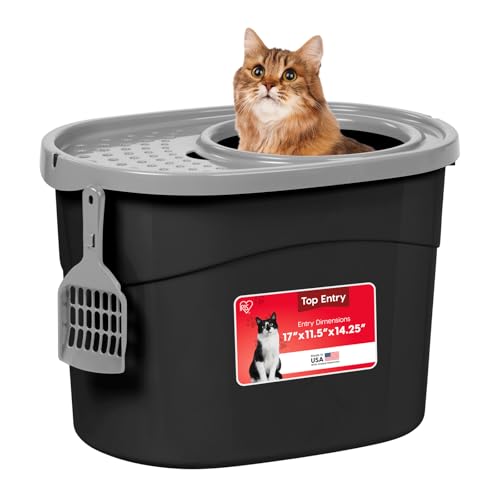
One example that works well is the IRIS USA large top-entry litter box.

IRIS USA top entry litter box with lid and high sides

View on Amazon

It has deep sides and a textured lid that gives cats a stable place to land and step out, while keeping the litter area out of reach for most small and medium dogs.

This setup also helps with litter tracking. As the cat climbs out, loose litter falls back inside instead of spreading across the floor.

Works best when:

  • your cat can jump comfortably
  • your dog is small or medium-sized
  • the box is placed where the dog cannot reach down into it

When it doesn’t work as well:

Large dogs may still be able to reach into the opening, especially if the box sits low on the floor.

It can also be difficult for older cats. If jumping in and out feels uncomfortable, they may start avoiding the box.

Stability matters too. If the box is too light, a determined dog may push or tip it to get access.

2. Litter Box Furniture (Best for Clean, Hidden Setups)

Litter box furniture hides the box inside a cabinet, which makes it much harder for a dog to access what’s inside.

If you want to see more designs that blend into your home, take a look at these 10 best litter box enclosure furniture options that actually look good.

Instead of a direct opening, most designs use a side entrance or a short internal path. That extra distance is often enough to stop a dog from reaching the litter, especially if the entry is sized properly.

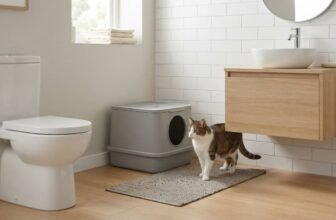
One example that works well is the Homhedy litter box enclosure with a side entry and cabinet doors.

Homhedy litter box enclosure cabinet with side entry and barn doors

View on Amazon

It’s large enough to fit most standard litter boxes, and the enclosed cabinet design keeps everything out of direct reach. The double doors make cleaning easier, and the side entrance can be positioned on either side depending on your space.

Works best when:

This type of setup also works well in living areas. It looks like a normal piece of furniture, so the litter box isn’t the first thing you notice when you walk into the room.

Another option is a more modern style like the Evermagin walnut litter box enclosure.

Evermagin walnut litter box enclosure cabinet with side entry and double doors

View on Amazon

It has a clean, furniture-style design that blends in easily with living room or bedroom setups. The side entry can be installed on either side, which makes it easier to position in tighter spaces.

Inside, there’s enough room for most standard and larger litter boxes, and the double doors make cleaning more straightforward.

This type of design works well if you want something that looks less like a litter box and more like part of the room, while still limiting direct access.

When it doesn’t work well:

If the opening is too large, some dogs will still try to squeeze in or reach inside.

Airflow matters here. If the enclosure traps odor or feels too closed in, some cats may avoid using it.

Cleaning can take more effort depending on how easy it is to access the inside.

3. Hidden Entry and Multi-Level Litter Box Designs

Some litter box setups work by adding distance and structure instead of just covering the box.

These designs use side entrances, internal compartments, or multi-level layouts that force the cat to move through a space before reaching the litter area. That extra separation makes it much harder for dogs to reach inside.

Dogs usually approach directly and try to access the litter from the front. When the opening is off to the side and the litter box sits deeper inside, that direct path is gone.

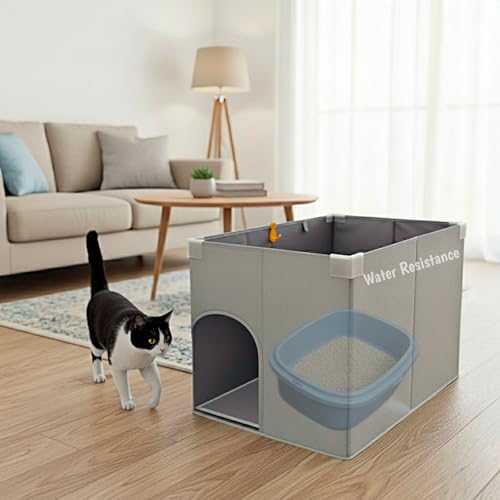
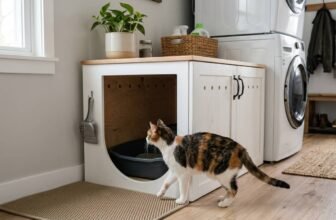
One example is a multi-level litter box enclosure like the HOOBRO litter box cabinet with a side entry and enclosed lower compartment.

HOOBRO litter box enclosure cabinet with side entry and multi level design

View on Amazon

The litter box sits inside the lower cabinet, while the side opening creates a more controlled entry point. The added structure makes it harder for dogs to reach in, especially compared to standard front-entry boxes.

This type of setup also creates a more private space for the cat, which can help reduce stress in busy homes.

Works best when:

  • the entry is offset and not directly visible
  • the litter box sits deeper inside the enclosure
  • your dog tends to give up when access is not immediate

When it doesn’t work well:

Very large or persistent dogs may still try to reach inside if the opening is wide enough.

Some setups require assembly, and stability depends on how well it’s put together.

4. Barrier-Based Setups (Most Reliable for Stubborn Dogs)

Sometimes the most effective dog proof litter box solution has nothing to do with the litter box itself.

Blocking access completely is often the only thing that works for determined dogs. Instead of relying on the box design, this approach creates a space that only your cat can enter.

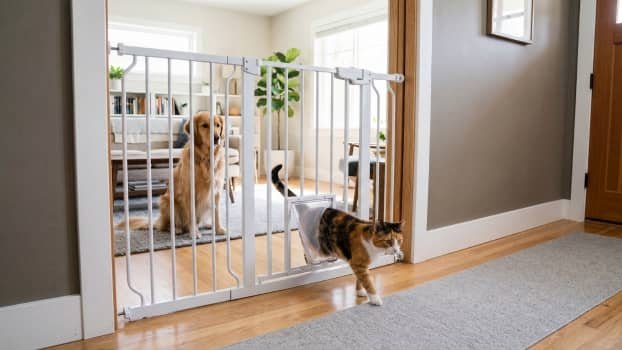
A simple way to do this is with a baby gate that includes a small pet door.

cat walking through pet gate while dog is blocked on the other side

A pet gate with a small cat door creates a simple way to keep dogs out of the litter box area.

One example that works well is an extra-tall walk-through pet gate with a built-in cat door, which creates a clear separation between pets.

extra tall pet gate with built in cat door blocking dog access

View on Amazon

The main gate blocks the dog from entering the area, while the small door allows your cat to pass through freely. This creates a dedicated space where the litter box stays completely out of reach.

This setup works especially well in doorways, hallways, or entrances to laundry rooms and bathrooms.

Once the dog no longer has access, the behavior usually stops because the opportunity is gone.

Works best when:

  • your dog is persistent or highly motivated
  • other litter box setups have not worked
  • you can block off a specific room or area

When it doesn’t work well:

Very small dogs may still fit through the cat door if the opening is too large.

Some cats may take a little time to get used to using the smaller entry.

5. Elevated Litter Box Setups (Simple Fix for Small Dogs)

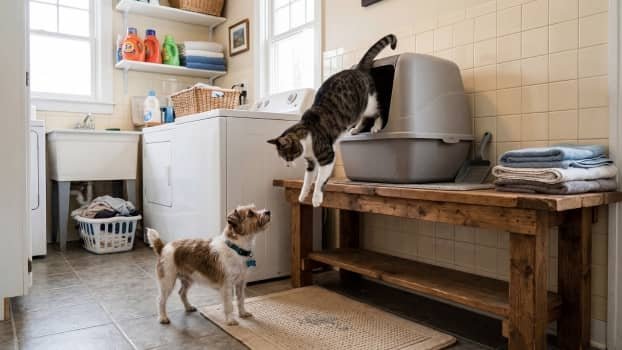
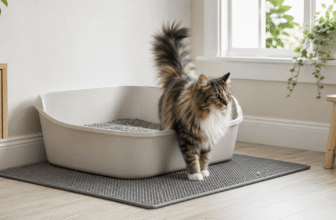
Raising the litter box off the ground can block smaller dogs without changing the box itself.

cat stepping down from elevated litter box while small dog looks up

Raising the litter box makes it easy for cats to access while keeping dogs from reaching inside.

Cats can jump up easily, while small dogs usually cannot reach the height. That alone is often enough to stop the problem, especially if the dog isn’t very determined.

This can be as simple as placing the litter box on a sturdy bench, shelf, or platform. The key is making sure the surface is stable and does not shift when the cat jumps up or down.

Height matters here. If the dog can still reach up or lean against the surface, it won’t be effective. The goal is to put the litter box just out of reach while keeping it comfortable for the cat.

This approach also works well combined with other setups. For example, placing a top-entry litter box on an elevated surface adds another layer of protection.

Works best when:

  • your dog is small
  • your cat is comfortable jumping
  • you have a stable surface available

When it doesn’t work well:

Larger dogs may still be able to reach up or lean against the surface.

Older cats or cats with mobility issues may avoid using a raised setup.

Can You Train a Dog to Stay Away From the Litter Box?

Training can help, but it usually doesn’t solve the problem on its own.

Dogs are driven by smell and habit, and the litter box is a strong trigger. Even well-trained dogs may go back to it when you’re not around.

Training works best as a backup to a physical setup. Once access is blocked, training becomes much more effective because the dog no longer gets rewarded for the behavior.

FAQ

Why does my dog keep going to the litter box? 

It smells like food, and once the behavior starts, dogs tend to repeat it because the reward is consistent.

Is there a completely dog proof litter box? 

No single design works in every situation. The most reliable setups combine the right box with limited access.

Do covered litter boxes stop dogs? 

Most do not. The front opening still allows dogs to reach inside.

What is the easiest solution that works quickly? 

Blocking access with a gate or separate space is usually the fastest and most reliable fix.

Final Thoughts

A dog proof litter box is really about control, not just design.

Once your dog no longer has access, the behavior usually stops. That’s why setups that physically block access tend to work better than anything else.

The best approach is to choose a solution that fits both your dog and your cat, then make small adjustments if needed. In some cases, one change is enough. In others, combining two simple fixes solves it completely.

Perfect Litter Box
Logo