Disclaimer: This post may contain affiliate links. As an Amazon Associate, we earn from qualifying purchases.
Last updated on October 7, 2026
The best covered litter box is one your cat fits inside and you can scoop without taking the whole thing apart. A hood can help contain the view and kicked litter, but the design also reduces usable interior space.
Check four things before the brand: the inside size, how the lid opens for scooping, the entry, and the seam where the pan meets the hood.
The five boxes below each earn their spot for a different reason. Still deciding between covered and open? Start with our guide on whether a closed litter box is better.
Quick Picks
High Back Wall Pick: Amazon Basics No-Mess Hooded
Removable-Hood Pick: IRIS USA Jumbo Enclosed
3-in-1 Stainless Pick: Yangbaga Covered Litter Box
Slide-Out Pan Pick: Marchul Enclosed Stainless Steel
Covered Pad-System Pick: Tidy Cats Breeze Covered
What to Check on a Covered Litter Box
Inside size, not outside size. A hood eats into the space. IRIS lists its Jumbo at 21 x 18.75 inches outside but 15.25 x 14 inches inside. A common guideline is a box about 1.5 times your cat’s length from nose to the base of the tail, so go by the inside numbers when the maker lists them.
How you scoop. A flip-back lid or a slide-out pan can make routine scooping simpler than removing the entire hood.
The entry. A flap keeps litter in, but some cats won’t push through one. Check whether the door comes off, or whether the box has an open front instead.
The seam. Urine that runs down the wall to the joint between pan and hood can leak out at the bottom on some designs. A high back wall, an inner baffle or a seamless base all target that spot.
Covered Litter Box Comparison
| Box | Material | Lid Access | Entry | Listed Size |
|---|---|---|---|---|
| Amazon Basics No-Mess Hooded | Plastic | Lid opens along the top; hood lifts off | Swinging door | 21 x 16 x 15 in (Standard) |
| IRIS USA Jumbo Enclosed | Plastic | Hood unbuckles and lifts off | Detachable flap | 21 x 18.75 x 17 in outside; 15.25 x 14 in inside |
| Yangbaga Covered | Stainless steel | Flip-top lid | Front entry, top exit; runs enclosed, semi-open or open | 24 x 16 x 16 in |
| Marchul Enclosed Stainless | Stainless steel | Pan slides out like a drawer | Single front door | About 20.1 x 16.1 x 15 in |
| Tidy Cats Breeze Covered | Plastic | Hinged hood flips back | Open front, about 10.25 x 9.25 in | About 21.5 x 16.5 x 16.5 in |
Amazon Basics No-Mess Hooded Enclosed Cat Litter Box

Why It Stands Out
The back wall rises higher than the front, which suits cats that aim backward. One reviewer says it was the first box to contain a back-spraying cat. The lid opens along the top, so you can scoop without lifting off the hood. Several reviewers say their cats used it within minutes of setup.
Possible Downsides
The Standard size is 21 x 16 x 15 inches outside. That’s smaller than the IRIS Jumbo’s outside footprint. Amazon also sells a Large version, so measure your cat before choosing.
Best For
Average-size cats that spray toward the back of the box.
IRIS USA Jumbo Enclosed Litter Box
Why It Stands Out
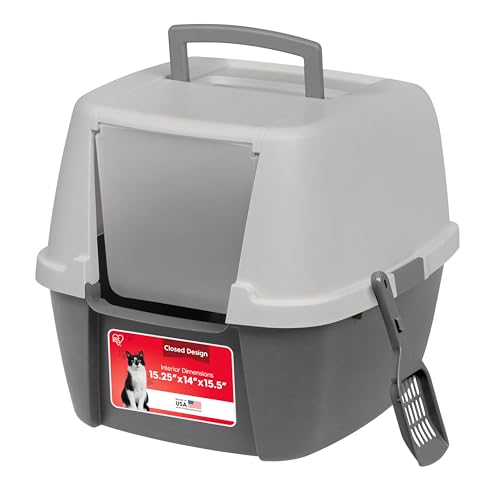
The hood unbuckles and lifts off completely, so the whole pan goes to the tub for a full wash. A handle on top makes it easy to carry there. The flap door detaches. The pan has curved sides that are easier to scoop, and the included scoop clips onto the top.
Possible Downsides
“Jumbo” describes the outside. Inside, IRIS lists 15.25 x 14 x 15.5 inches, which is tight for a big cat.
Best For
Small to medium cats, and owners who wash the whole box often.
Yangbaga Covered Cat Litter Box
Why It Stands Out
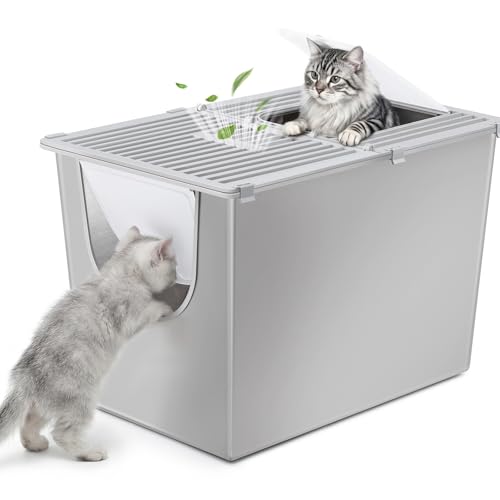
This stainless steel box runs three ways: fully enclosed, semi-open or fully open. You can start with it open and close it up later without buying a second box. Cats enter at the front and can exit through the top. The lid flips back for scooping, and the carbon filter compartment swaps without tools. Yangbaga states the base is seamless and welded, and lists a 25 lb weight capacity.
Possible Downsides
At 24 x 16 x 16 inches overall, it’s the longest box here. Measure the spot where it will go as well as your cat.
Best For
Cats that have turned down hooded boxes before, and owners who want a steel pan.
Marchul Enclosed Stainless Steel Cat Litter Box

Why It Stands Out
The stainless litter pan slides out like a drawer, so you pull it forward for cleaning instead of reaching through the hood. One reviewer says it slides smoothly. Marchul lists baffles inside to stop urine leaking at the joints.
Possible Downsides
Size is the open question. Marchul lists it at about 20.1 x 16.1 x 15 inches and says it fits cats up to about 12 lb. Some reviewers say a 15 lb cat or a Maine Coon fits fine, while others say it was too small. Check your cat’s length against those numbers.
Best For
Smaller cats, and owners who’d rather slide out a pan than lift a lid.
Tidy Cats Breeze Covered Litter Box System
Why It Stands Out
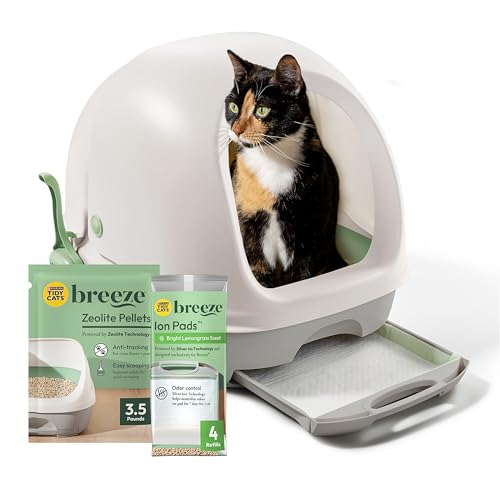
This isn’t a regular hooded pan. Pellets sit in a top tray, and urine passes through to a pad in the tray below, so you only scoop solids. The hinged hood flips back for scooping. Purina designs the larger pellets to reduce tracking, and many owners report less litter around the box. Purina lists the front opening at about 10.25 inches high by 9.25 inches wide, starting 5.5 inches off the floor.
Possible Downsides
It only works with Breeze pellets and Breeze pads. Purina says not to substitute regular litter or other pads, so you’re tied to buying both.
Best For
Owners who want the Breeze pad-and-pellet routine with a hood. Our Breeze litter box review covers how the system works.
Frequently Asked Questions
Why does my covered litter box leak at the bottom?
Check the seam where the hood meets the pan. Urine aimed high can run down the wall and reach that joint on some designs. High back walls, inner baffles or a seamless base can help contain it.
Does a carbon filter make a covered box smell-free?
No. A filter is an extra, not a fix. Odor in a covered box comes mostly from the litter and how often you scoop. Our guide to the best cat litter for odor control covers which litters to pair with a hood.
Will a hood stop my cat peeing over the side?
A hood can contain urine aimed above the wall of an open pan. If liquid is escaping near floor level, check the seam between the pan and hood as well.
Can a covered box work with more than one cat?
A covered box has a narrower way in and out than an open pan. In a multi-cat home, keep enough boxes in separate spots and include an open one if that suits your cats better. See our guide to the best litter box for multiple cats.