Disclaimer: This post may contain affiliate links. As an Amazon Associate, we earn from qualifying purchases.
Last updated on October 7, 2026
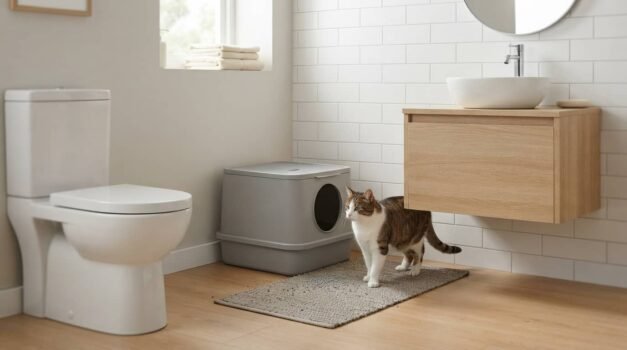
The best litter box for small bathrooms is the one whose shape fits the gap you actually have. A corner box uses dead space where two walls meet. A top-entry box needs no clear space in front of a doorway. A narrow box slips into a tight gap.
Measure the spot first, including room for your cat to approach. Then pick the shape that fits, and check that the inside is still big enough for your cat.
Still deciding where the box should go? Our guide on where to put a litter box in a small apartment covers placement.
Quick Picks
Large Corner Pick: Amazon Basics Corner with Lid
Compact Corner Pick: IRIS USA Enclosed Corner
Square Top-Entry Pick: IRIS USA Top-Entry Square
Narrow Top-Entry Pick: Arm & Hammer Premium Top Entry
Open Wall Pick: Vealind Large High Sided
Measure Before You Shop
The footprint shape. A rectangle against a wall still takes a rectangle of floor. A triangle fits the corner behind a toilet or vanity that a rectangle can’t use.
The approach. A front-entry box needs clear floor in front of its opening. A top-entry box doesn’t, but your cat still needs a clear path to reach it and room above to get in and out.
Inside versus outside. A compact outside footprint only helps if the usable interior still fits your cat. Check inside dimensions when the maker provides them, and see our extra large litter box guide for the full sizing method.
Small Bathroom Litter Box Comparison
| Box | Listed Size | Shape | Entry | Fits Where |
|---|---|---|---|---|
| Amazon Basics Corner | About 26.3 x 20.2 in footprint; 22.9 in high | Triangle, covered | Front | A roomy empty corner |
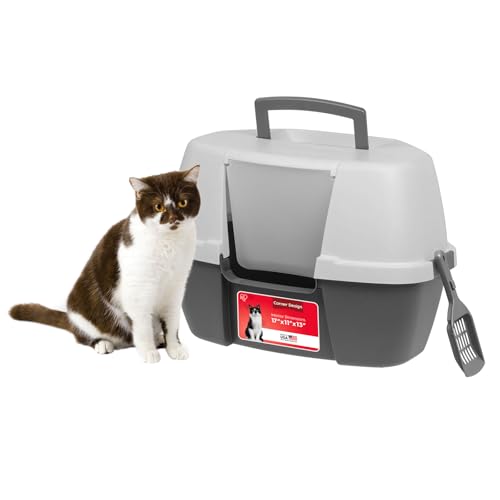
| IRIS Enclosed Corner | 21 x 16.13 x 14.25 in outside; about 17 x 11 in inside | Triangle, covered | Front with flap | A tighter corner |
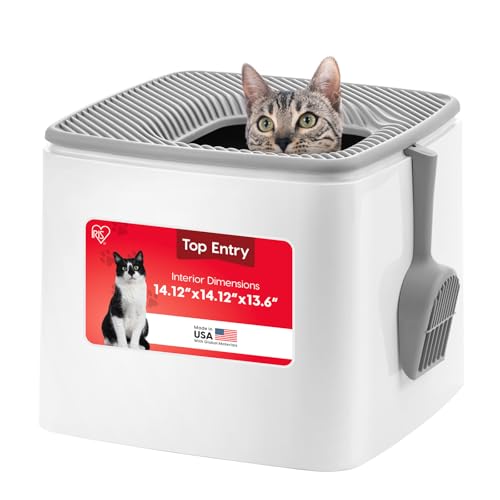
| IRIS Top-Entry Square | 17.25 x 17.25 x 14.88 in outside; 14.13 in square inside | Square, top entry | Top | A small square spot with no front clearance |
| Arm & Hammer Top Entry | 20 x 15 x 15 in | Narrow rectangle, top entry | Top | Where 15 inches of width is the limit |
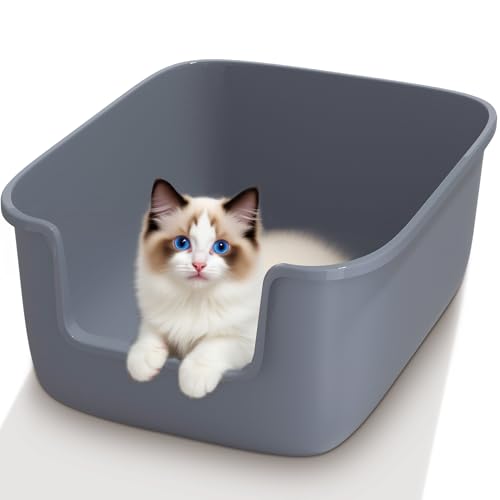
| Vealind Open | 19.7 x 15.7 x 8.7 in | Open rectangle | Low front | Flat against a wall |
Amazon Basics Cat Litter Box with Lid (Corner)
Why It Stands Out
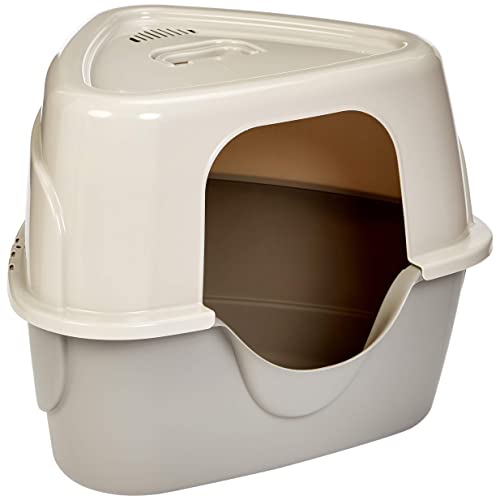
The triangle sits flush against both walls, so a fairly roomy covered box tucks into a corner instead of sticking into the room. Reviewers say it fit spots where rectangular boxes didn’t, and report larger cats using it comfortably. The sloped inside makes the corners quicker to scoop.
Possible Downsides
At about 26.3 x 20.2 inches, it needs a good-sized corner. Its triangular footprint makes the most sense in a corner. Against a straight wall, a rectangular box may use the space more efficiently.
Best For
Bathrooms with an empty corner but no good stretch of straight wall.
IRIS USA Enclosed Corner Litter Box
Why It Stands Out
It’s the smaller of the two corner boxes, at 21 x 16.13 inches outside. The hood opens for scooping, which helps when there’s nowhere to set a lid down. The flap can be left off for cats that won’t push through it.
Possible Downsides
The usable interior is about 17 x 11 inches, so it can get tight for a larger cat even though the outside looks roomy.
Best For
Tight bathroom corners and smaller cats.
IRIS USA Top-Entry Square Litter Box
Why It Stands Out
At 17.25 inches square, it has the smallest footprint here, if only just. Cats enter from the top, so there’s no doorway that needs clear floor in front. The grooved lid catches litter from paws. Several reviewers report needing less cleanup around the box, and some stopped using a separate mat.
Possible Downsides
The inside is about 14 inches square, which suits average-size cats, not big ones. Your cat has to climb in and out through the top.
Best For
Average-size, agile cats in the smallest bathrooms.
Arm & Hammer Premium Top Entry Litter Box

Why It Stands Out
At 15 inches wide, it’s the narrowest box here. Its 15-inch width makes it useful where width is the limiting measurement. Reviewers like the flat sides, which give the scoop a wall to scrape clumps against.
Possible Downsides
It’s 20 inches long, so check the depth of the space as well as the width. Like the IRIS, it’s top entry only.
Best For
Narrow spots where length is less of a limit than width.
Vealind Large High Sided Litter Box
Why It Stands Out
It’s an open box with a 4.72-inch front entry and higher walls on the other three sides. Your cat walks straight in, and the higher surrounding walls are designed to contain kicked litter. Reviewers say it fit a small bathroom and a motorhome cabinet. The coated, rounded inside is quick to scoop.
Possible Downsides
At 8.7 inches high, it doesn’t give the full-height containment of a covered or top-entry box.
Best For
Cats that won’t use covered or top-entry boxes.
Frequently Asked Questions
What size litter box fits next to a toilet?
Measure the gap from the toilet to the nearest wall or vanity. If you have about 15 inches of width, a narrow top-entry box may fit. Leave a clear approach and enough space above the box for your cat to enter and exit comfortably.
Is a corner box more space-efficient than a rectangular box?
Only when the space is actually a corner. A triangular box uses the meeting point of two walls well, while a rectangular box usually makes better use of a straight stretch of wall. Measure the exact footprint before choosing.
Does a top-entry box save bathroom floor space?
Not automatically. Its advantage is that it doesn’t need a front doorway, but the box still needs enough floor area and clear space above for your cat. Compare the actual length and width rather than assuming top entry means smaller.
Is a corner litter box big enough for my cat?
It depends on the box. The Amazon Basics corner box is much bigger than the IRIS corner box. Compare your cat’s length with the inside of the box, not the size label.