Disclaimer: This post may contain affiliate links. As an Amazon Associate, we earn from qualifying purchases.
Last updated on October 5, 2026
Clumping crystal cat litter is a confusing label, because standard crystal litter is usually non-clumping. Some products are specifically sold as clumping silica or clumping crystal, and they don’t all use the same formula.
This guide explains what standard crystal litter does, what “clumping crystal” can mean on a bag, and how to choose the right routine for your box.
Does crystal cat litter clump? Usually not. Standard silica-gel crystal litter absorbs urine into the crystals rather than forming scoopable urine clumps. Products marketed as “clumping crystal” need to be checked individually, because the formula may differ from standard crystal litter.
| Litter Type | What Happens to Urine | Daily Routine |
|---|---|---|
| Standard crystal litter | Absorbed into the crystals | Remove solids, stir, replace the batch as directed |
| Litter labeled “clumping crystal” | Varies by product | Follow that bag’s directions |
| Clumping clay | Forms scoopable clumps | Scoop clumps and solids, top up |
Does Crystal Cat Litter Clump?
Usually not. Standard crystal litter typically absorbs urine rather than forming a scoopable urine clump. It’s made of silica gel beads that soak up urine and hold it.
Fresh Step and Purina both tell owners of their crystal litters to remove solid waste and stir the crystals instead. Our crystal cat litter pros and cons guide explains that routine in full.
What “Clumping Crystal” Can Mean on a Label
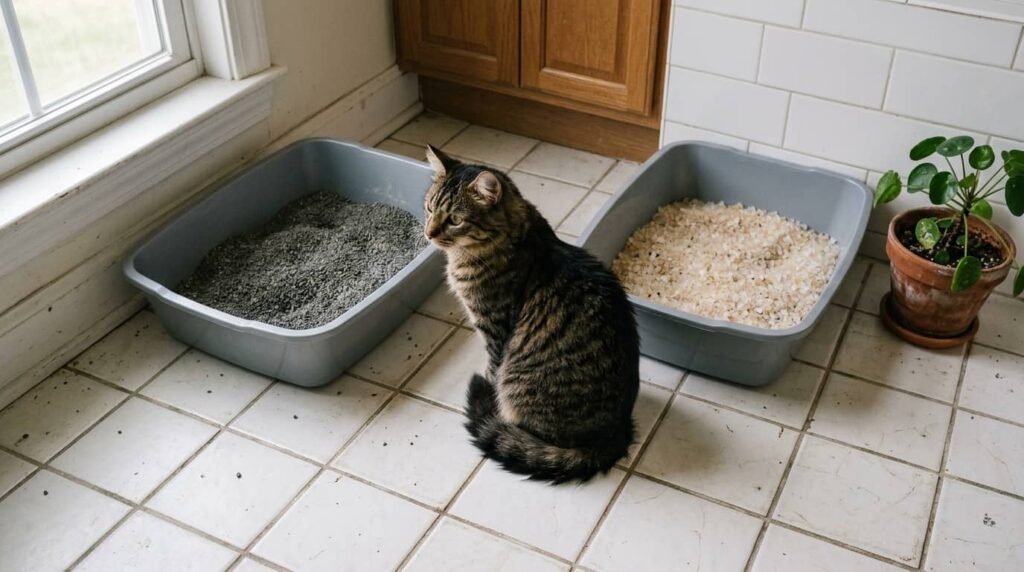
Some brands do sell litter labeled as clumping crystal or clumping silica. Ultra by Cat’s Pride Unscented Clumping Micro Crystals, Fresh 4 Life Clumping Crystals and Cat Love Power Mix are examples of the label, not picks.
These products don’t necessarily use the same formula. Cat Love Power Mix, for example, lists silica and cornstarch as its ingredients, while other clumping-crystal listings don’t clearly explain the clumping mechanism. Check the ingredient list and follow that specific bag’s directions rather than assuming it works like standard crystal or clumping clay.
Why Not Mix Crystal and Clumping Litter Yourself?
Crystal and clumping litters come with different directions. One says to stir and replace the whole batch, and the other says to scoop out clumps and top up.
If you mix the two yourself, the resulting blend is no longer the product described by either package’s directions. Unless a manufacturer specifically instructs you to mix litters, follow the directions for the product you’re using.
If you’re thinking about mixing litters to suit an automatic box, check the machine’s manual instead.
How to Choose the Right Routine
Choose standard crystal litter if you’re happy to stir and replace the whole batch, or you use a box designed for crystals, like PetSafe’s ScoopFree Crystal boxes. If you want one with no added fragrance, PetSafe ScoopFree Sensitive Crystal Litter works in standard boxes and in ScoopFree Crystal boxes. Our best crystal cat litter guide compares more brands.
Choose clumping litter if you want to scoop urine clumps out each time, or your automatic box needs clumping litter. If a light bag and low dust are what drew you to crystal, Tidy Cats LightWeight 4-in-1 is a clumping clay that Purina says is 50% lighter than the leading clumping litter. Our clumping vs non-clumping cat litter guide walks through the bigger decision.
Frequently Asked Questions
Does clumping crystal litter work in automatic litter boxes?
It depends on the product and the machine. Follow your machine’s manual and the litter maker’s guidance before trying any crystal litter in an automatic box.
Is clumping crystal the same as clumping clay?
No. “Clumping crystal” describes products sold as clumping silica or crystal litter, but formulas vary. Cat Love Power Mix, for example, lists silica and cornstarch. Check the ingredients and directions on the specific bag.
Is crystal litter good for kittens?
AAHA suggests starting kittens with unscented clumping litter, the litter they used before, or both. Standard crystal litter doesn’t clump, so it doesn’t match that suggestion.